How much does custom software cost in 2026? Realistic price ranges for custom CRM, ERP, web apps and internal tools, what drives the cost, when SaaS is still the better choice, and Axisero's prices from €3,000.
How much does custom software cost in 2026? Realistic price ranges for custom CRM, ERP, web apps and internal tools, what drives the cost, when SaaS is still the better choice, and Axisero's prices from €3,000.
If you run a mid-sized business, you probably know the pattern. You pay for a CRM, a project tool, an invoicing app and a few others. None of them quite fits how your team works, so a collection of spreadsheets grows up beside them to fill the gaps.
Sooner or later someone asks the obvious question: what would it cost to build one system that does exactly what we need? This guide gives you an honest answer on custom software development cost in 2026. We cover realistic price ranges, what pushes the price up or down, and when paying monthly for SaaS is still the smarter choice.
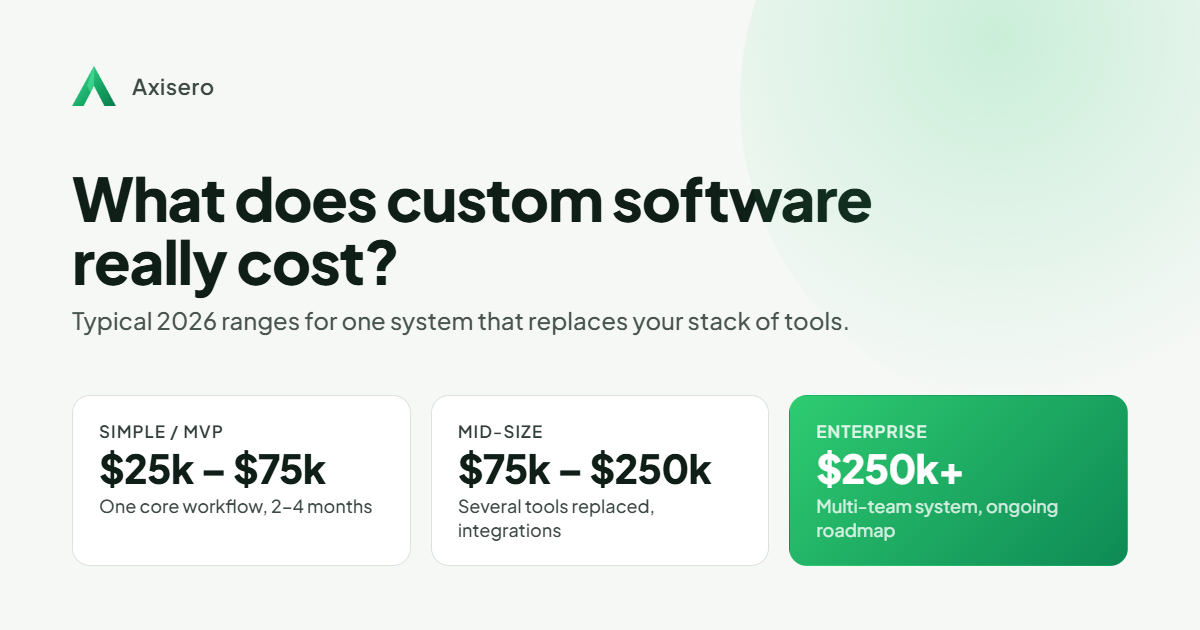
A small internal tool or a single module usually starts in the low tens of thousands. A custom CRM typically costs €15,000 to €35,000, and most mid-market custom ERP projects land between $100,000 and $250,000. On top of the build, plan for maintenance of roughly 15 to 20% of the build cost each year.
The exact figure depends on what the system needs to do, how many tools it connects to and how much data you bring across. The rest of this guide explains each of those.
At Axisero, projects start from €3,000 for one automated workflow and €6,000 for a starter custom CRM. See the full price list below.
Custom software is not one product, so it does not have one price. Here is what the most common project types include and what they typically cost. The ranges for internal tools, web applications and automation are typical industry figures, not fixed prices.
Internal tools are systems your own team uses every day: approval workflows, stock tracking, job scheduling, reporting dashboards. They usually replace a spreadsheet or a manual process that eats hours each week.
A web application is usually something your customers or partners use: a client portal, a booking system, an order tracker or a supplier dashboard. Because outsiders use it, design, security and reliability matter more.
A custom CRM holds your contacts, deals, quotes and follow-ups, shaped around how your team actually sells. Instead of adapting your process to the software, the software follows your process.
If you are deciding between fixing your current CRM, switching products or building your own, our guide to custom CRM systems walks through all three. You can also see how we build custom CRM and ERP systems.
An ERP connects the core of the business: inventory, purchasing, production, finance and often HR. It is the largest type of business system, which is why the price range is so wide.
The good news is that you rarely need the whole thing on day one. Most companies start with the module that causes the most pain.
Not sure whether you need a CRM, an ERP or both? Read CRM vs ERP: choosing systems that fit your business.
AI is useful when a task involves reading, sorting or drafting at volume: pulling data out of invoices, routing incoming emails, or preparing first drafts of routine replies. It works best as part of a system, not as a separate gadget.
Not every task needs AI, though. Sometimes a simple automation beats an AI agent, and it costs less to build and run. Our business process automation work covers both.
We keep our rates well below the market ranges above. These are starting prices, and we confirm the exact figure after a short discovery, once we understand your workflow.
You pay once for the build and you own the system. There are no per-user licence fees, however much your team grows. If you want to know how we arrive at a number, read pricing AI work without hand-waving.
Two projects with the same name can differ in price several times over. These are the factors that make the difference.
The biggest difference is how you pay. Off-the-shelf tools charge a subscription, usually per user, per month, for as long as you use them. Custom software is mostly a one-time cost: you pay to build it, then you own it.
That makes the one-time cost vs subscription software question a matter of time. Here is a simple, illustrative example for a 50-person team. The SaaS price is a made-up round number for the example; real prices vary widely.
At Axisero's prices, a custom CRM starts from €6,000, so the gap over three years is even wider.
This is one example, not a promise. For larger systems, the pattern is similar but slower: for ERP, total cost of ownership typically crosses over after 3 to 6 years, after which custom becomes the cheaper option (RaftLabs; CloudHouse).
Cost is only part of the picture. Software with no per user fees means you can add staff without a bigger bill, and the system does what your business needs rather than what suits the vendor's roadmap.
To be fair, custom software is not always the right answer. Off-the-shelf usually wins when:
Custom makes sense when you are paying for several tools that don't talk to each other, your team works around them in spreadsheets, and your process is part of what makes you different.
The build is the biggest number, but it is not the only one. Plan for these from the start so there are no surprises.
Timelines depend on scope, but these are realistic for most projects:
The biggest causes of delay are unclear requirements and slow feedback, not the coding itself. A short, well-defined first version almost always arrives faster.
That is why we map the workflow before we build: a week of watching how work really happens saves months of rework.
The most expensive way to build custom software is to try to build everything at once. The most reliable way is to start small and grow.
Pick the one process that hurts most. That might be quoting, stock control or job scheduling.
Build one core module for it. Keep the first version tight enough that your team can use it within weeks, not months.
Use it in real work. Real usage shows you what matters and what was a nice idea on paper.
Expand step by step. Add the next module only when the first one is proving its value.
This is how we work at Axisero. We start with discovery (1 to 2 weeks of workflow analysis and planning), then build in short development sprints with real-world testing, then improve and support the system as you grow. You see working software early, and you never pay for features nobody uses.
You can read more about our custom software development service, or see how we scope a project before any price is agreed.
It can be, if a manual process or a stack of subscriptions is costing you real time and money every month. Custom software cost for a small business is easiest to justify when you start with one module that fixes one painful process. If off-the-shelf tools already fit your work, they are usually the cheaper choice.
A common rule of thumb is around 15 to 20% of the original build cost per year. That covers bug fixes, security updates, hosting changes and small improvements. A system built for $40,000 would typically need around $6,000 to $8,000 a year to stay healthy, secure and up to date.
A focused internal tool or single module typically takes 6 to 10 weeks. A custom CRM or web application usually takes 2 to 4 months, and a multi-module ERP can take 4 to 12 months, delivered in phases. Clear priorities and quick feedback from your team are what keep a project on schedule.
Yes. With custom software you pay once to build the system and you own it, so there are no per-user licence fees as your team grows. You still pay for hosting and maintenance, but adding a new employee does not add a new monthly charge.
Custom software development cost in 2026 ranges from the low tens of thousands for a focused tool to several hundred thousand for a full ERP. Where you land depends on scope, integrations, data and security needs. The surest way to keep cost under control is to start with one core module and grow from there.
Price guides can only take you so far. Our starting prices give you a fair idea, and we confirm the exact figure after a short discovery, once we understand your workflow.
If you are weighing up custom software against another year of subscriptions, book a free 30-minute audit. We will look at how your team works today, tell you honestly whether custom software makes sense, and give you a real number.